Sourdough Puff Pastry made With Discard Starter
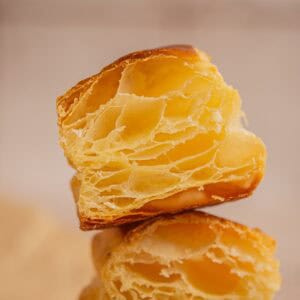
This sourdough puff pastry is made with discard sourdough starter, rolled with butter to make the lightest, flakiest layers. The sourdough starter adds a tang, and I also give the pastry and overnight ferment to make it better for digestibility and easier to roll out.

Discard starter pastry
There’s no need to feed your sourdough starter for this pastry, an unfed or discard starter is best. The pastry relies on bacteria in the starter to ferment the flour, not the yeast component of a starter. It’s the water that evaporates from the butter that gives puff pastry its rise.
Usually, puff pastry needs hours resting between each couple of turns to rest the gluten. This sourdough puff pastry requires a shorter amount of refrigerated resting during the folds, only really to keep the butter chilled.
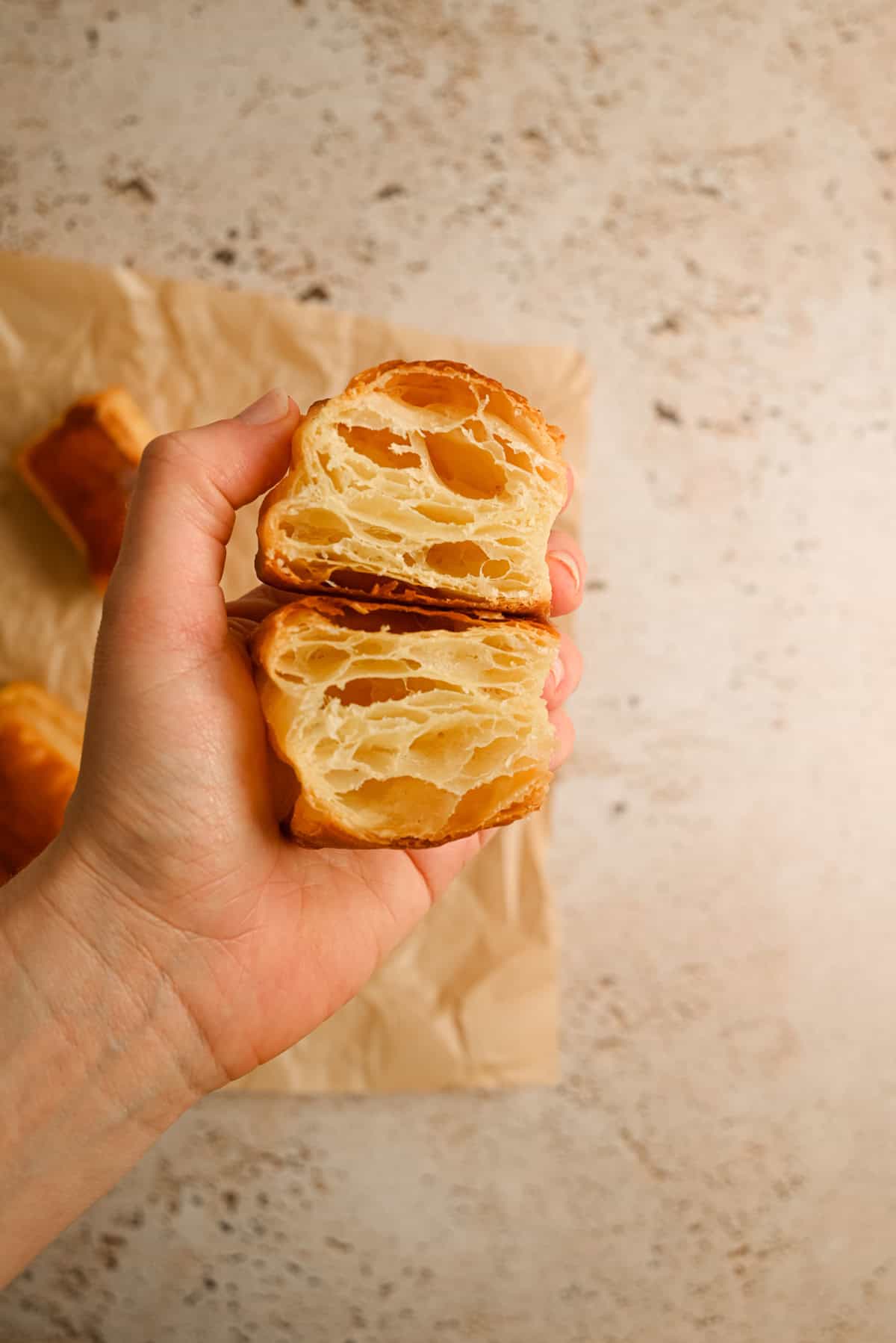
The components of puff pastry
Puff pastry has two main parts – the détrempe which is the dough (in this case, a sourdough dough) and the butter block (the beurrage.) The puff pastry is rolled out and folded multiple times to create the layers, and the ‘puff’. The fermented sourdough base dough is so pliable and doesn’t resist rolling the way that regular dough often can if it’s not allowed to rest.
Method
- The first step is to make the détrempe which is really easy to hand knead into a smooth and slightly tacky dough. I place this in the fridge for 8-20 hours to ferment, but you can cut this down to 1-2 hours if you like.
- Place butter between two sheets of parchment. Use a rolling pin to pound and shape it into a neat 6″ square. Chill until cold but still pliable.

- Once the dough has chilled, roll it into a 9″ rectangle.
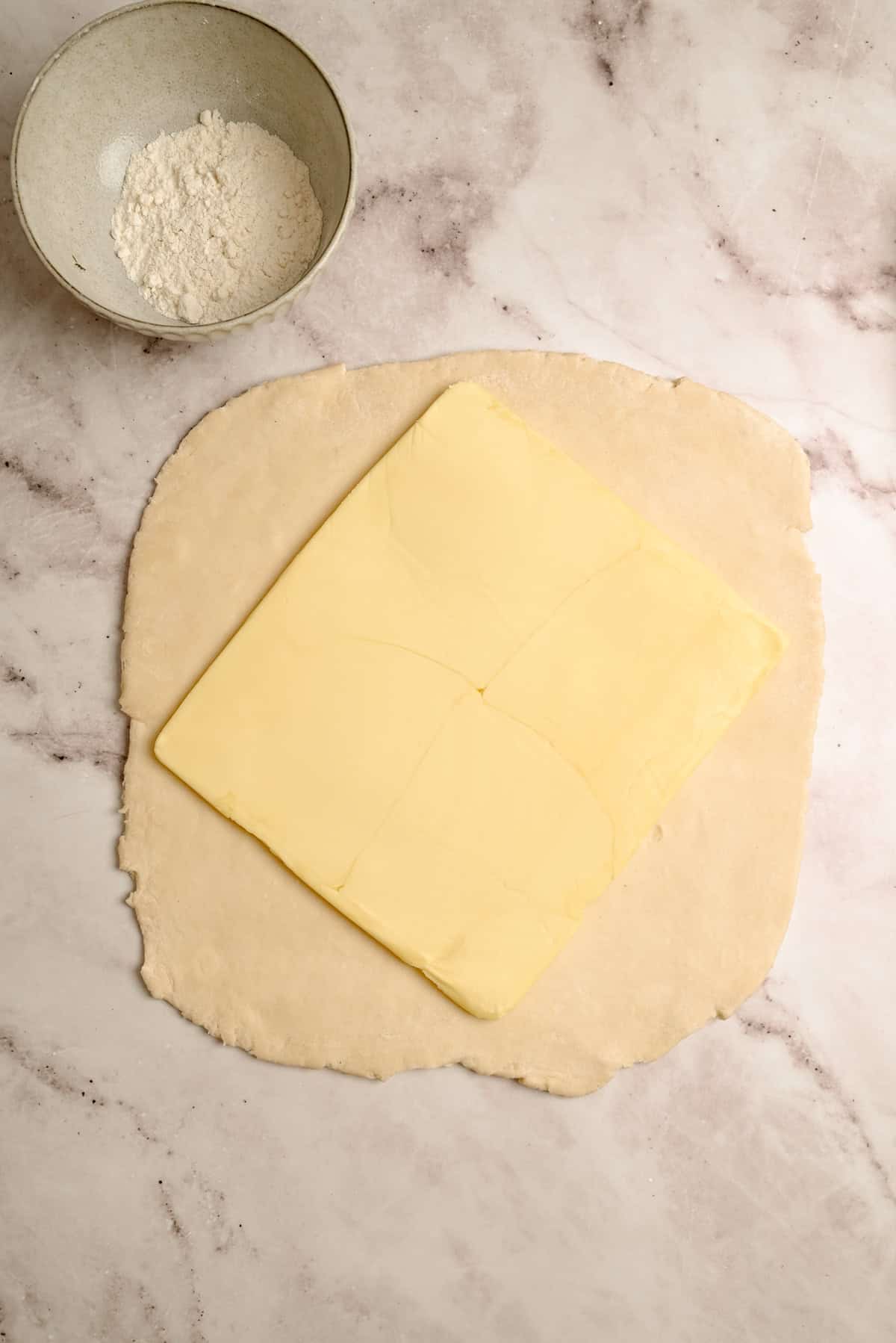
- Place chilled, pliable butter in the center
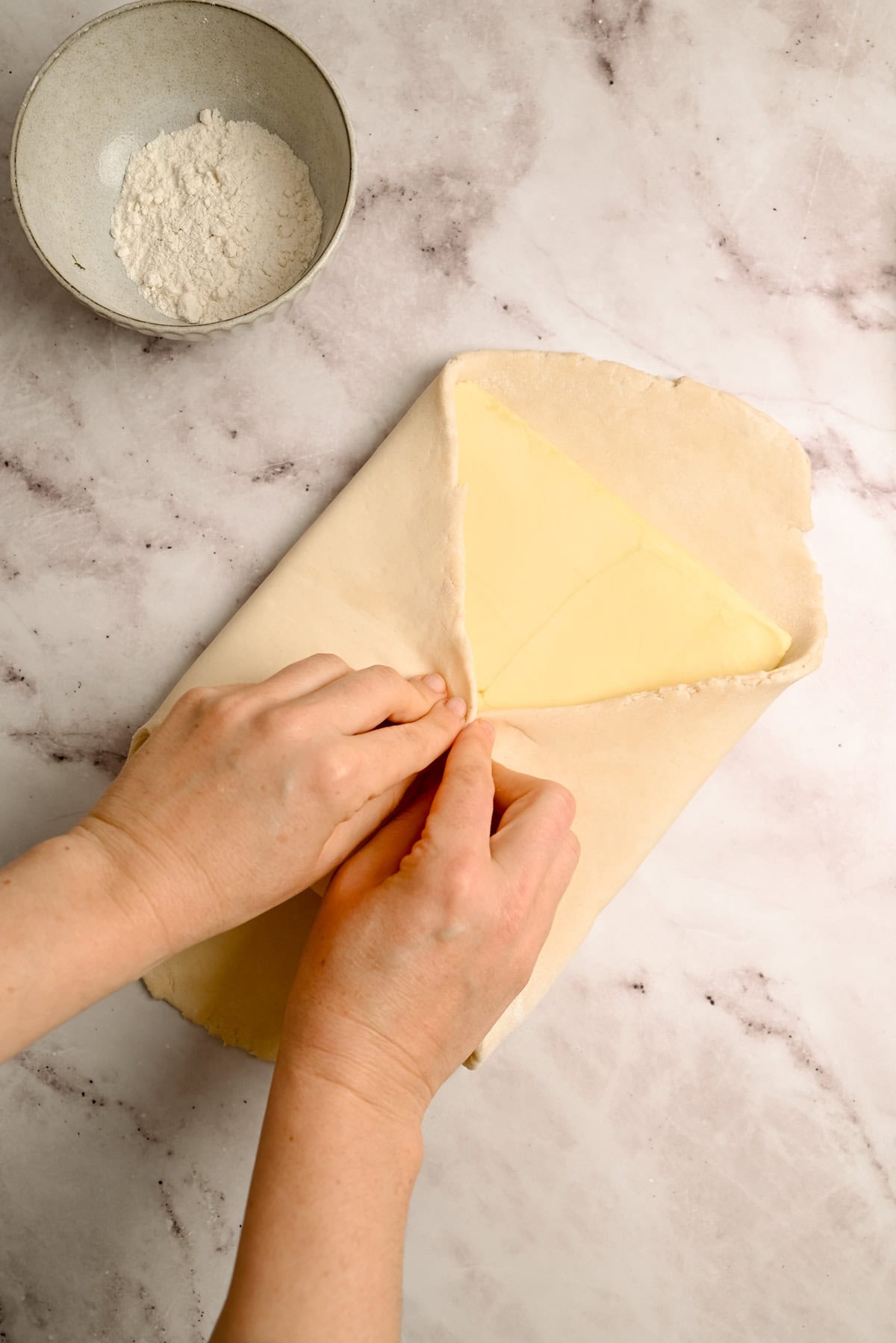
- Fold the dough over the butter from all sides, sealing the edges so the butter is fully wrapped.
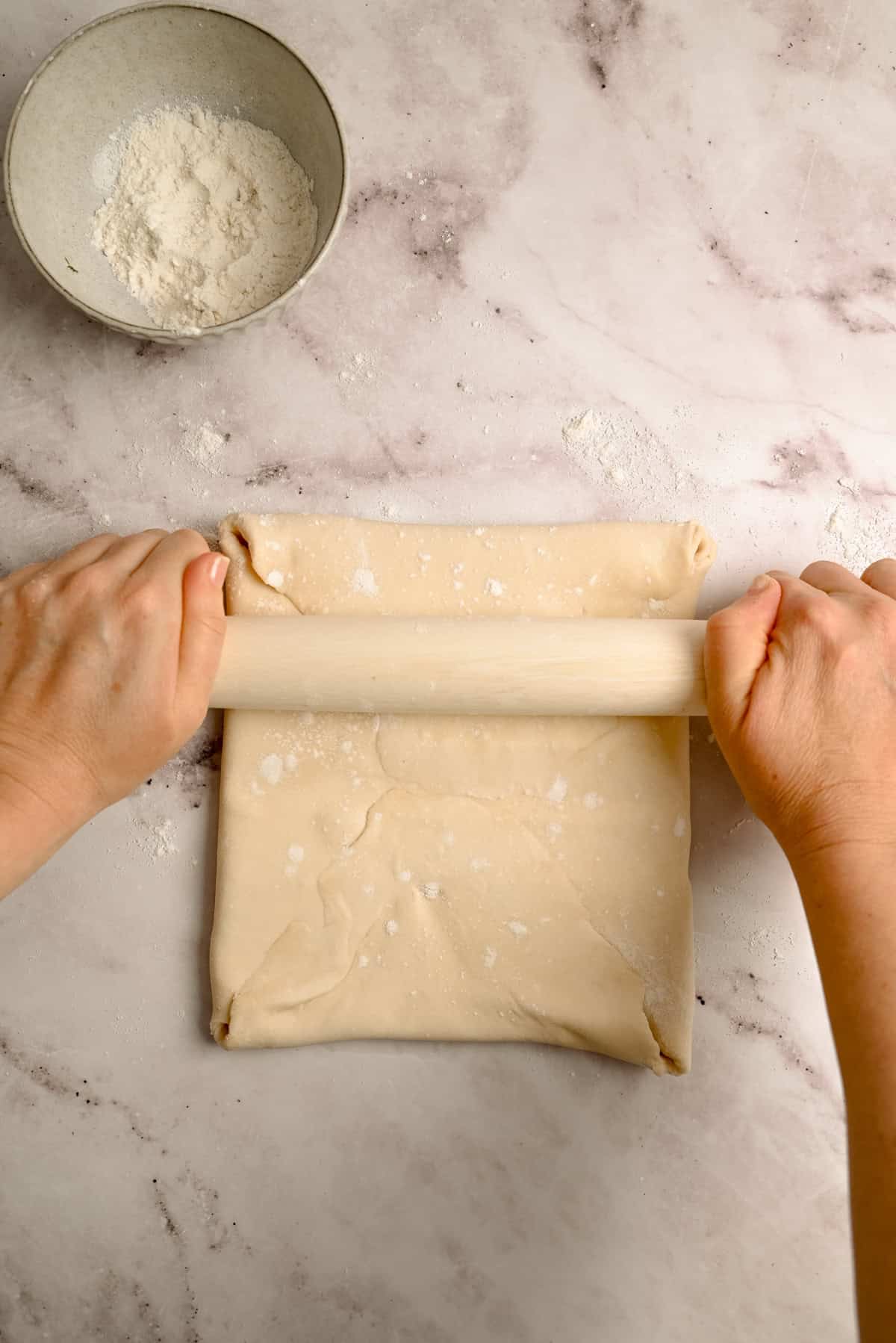
- Gently roll into a long rectangle.
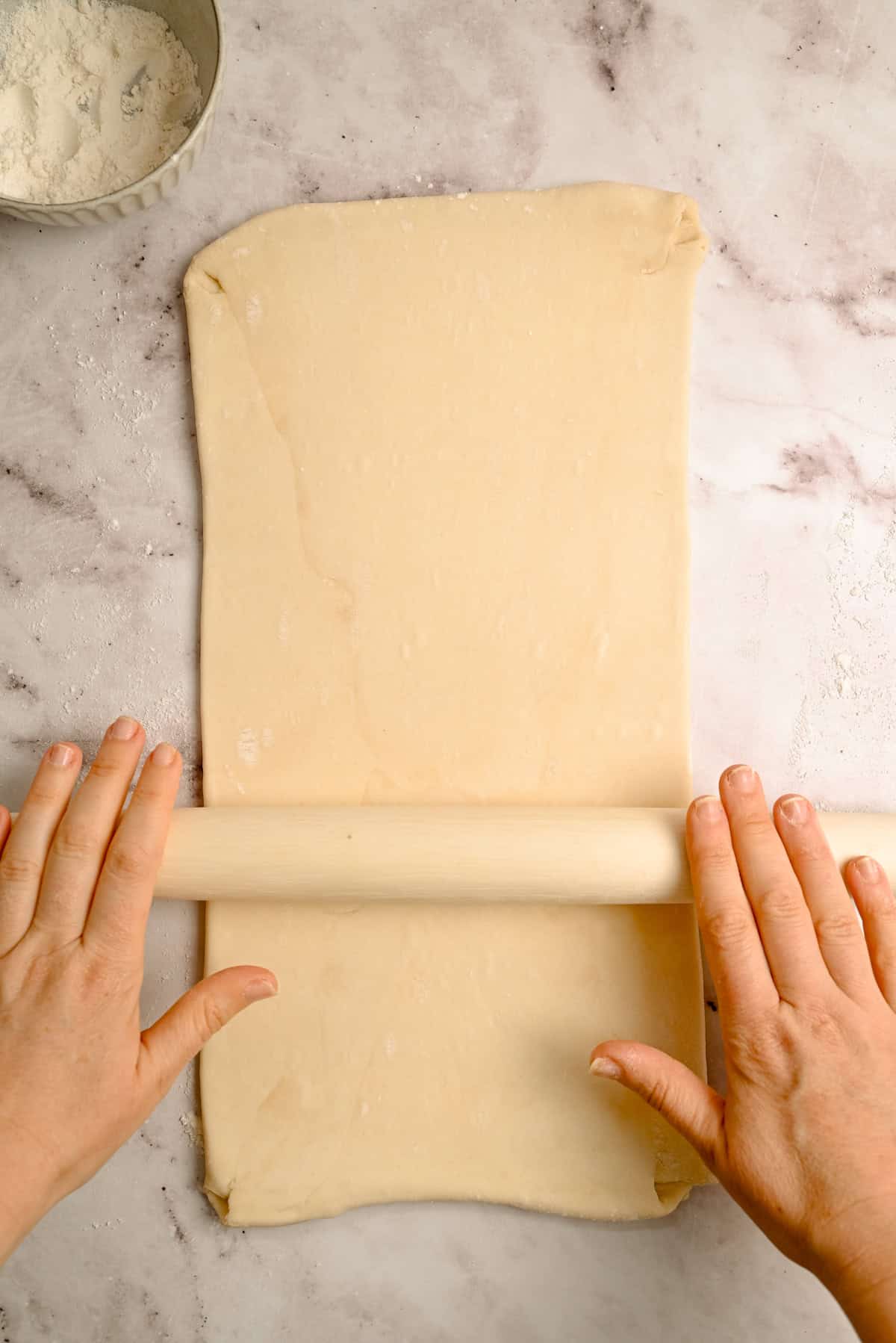
- Focus on keeping an even thickness.
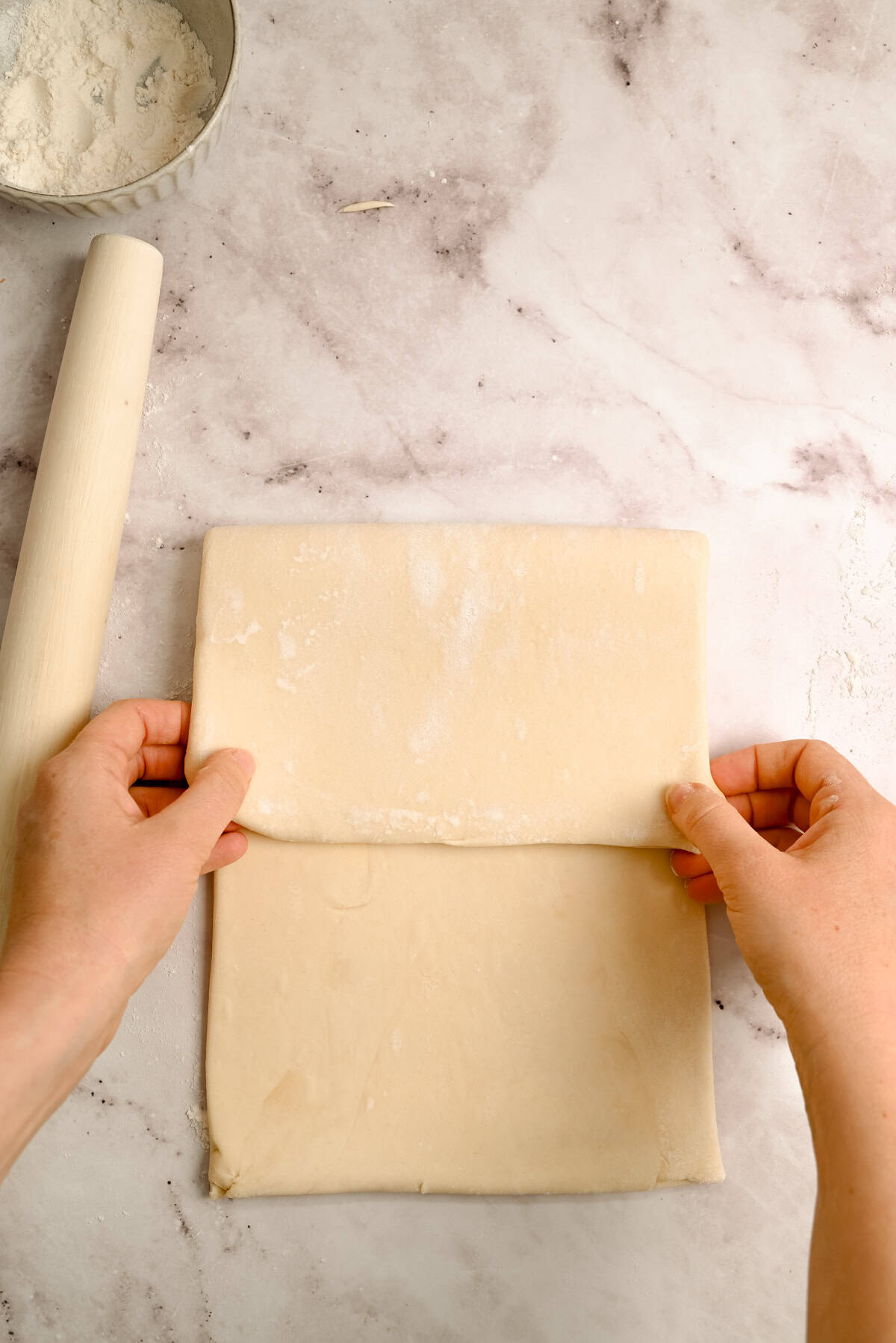
- Fold the top third down.
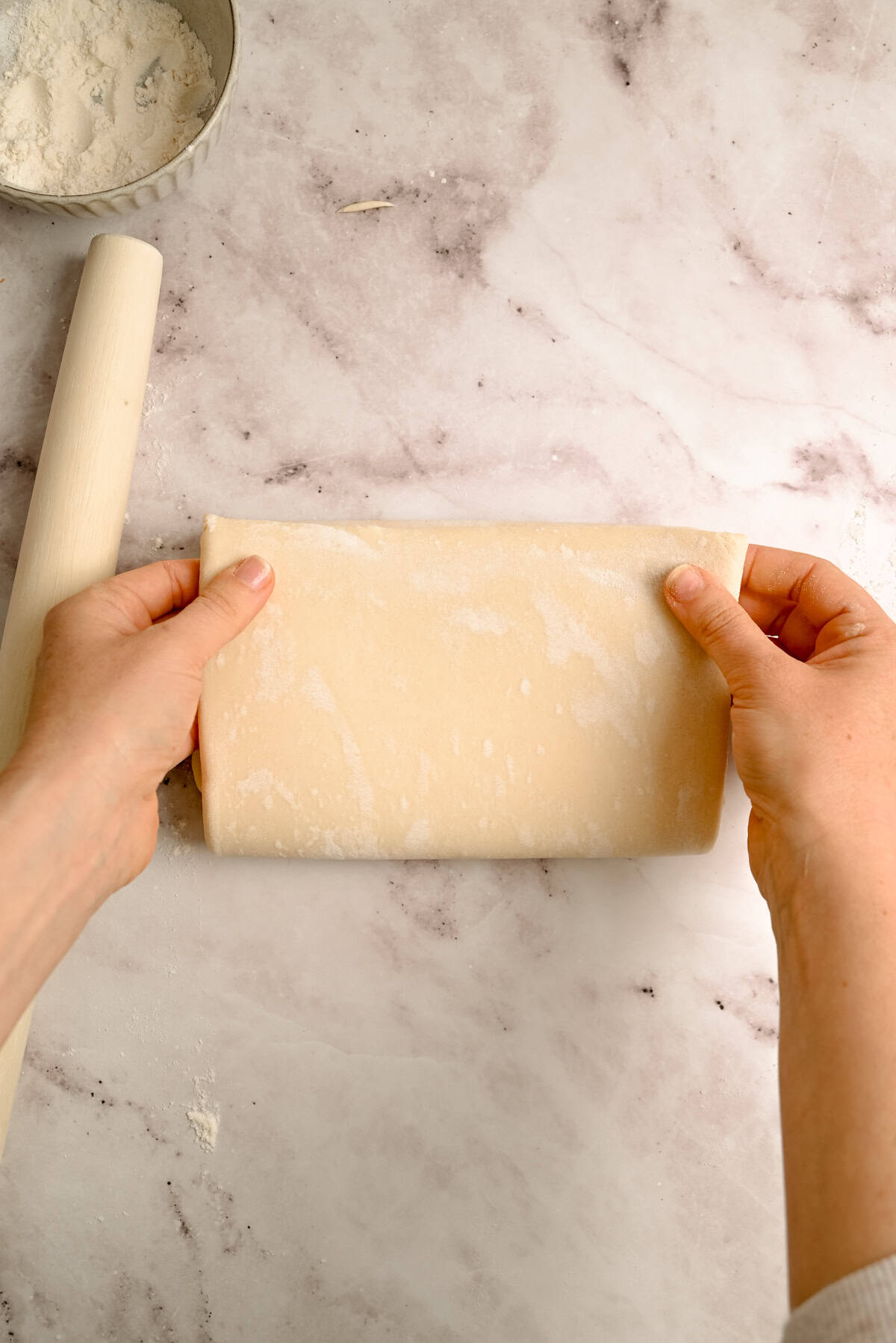
- Fold the bottom third up. This was a single turn.

- Rotate the dough 90°, roll again into a rectangle, fold again into thirds. This completes 2 turn.
- Wrap the dough and chill for 20–30 minutes to keep butter cold and relax the gluten. Continue with 4 more turns, so there are 6 in total, chilling between every 2 turns.
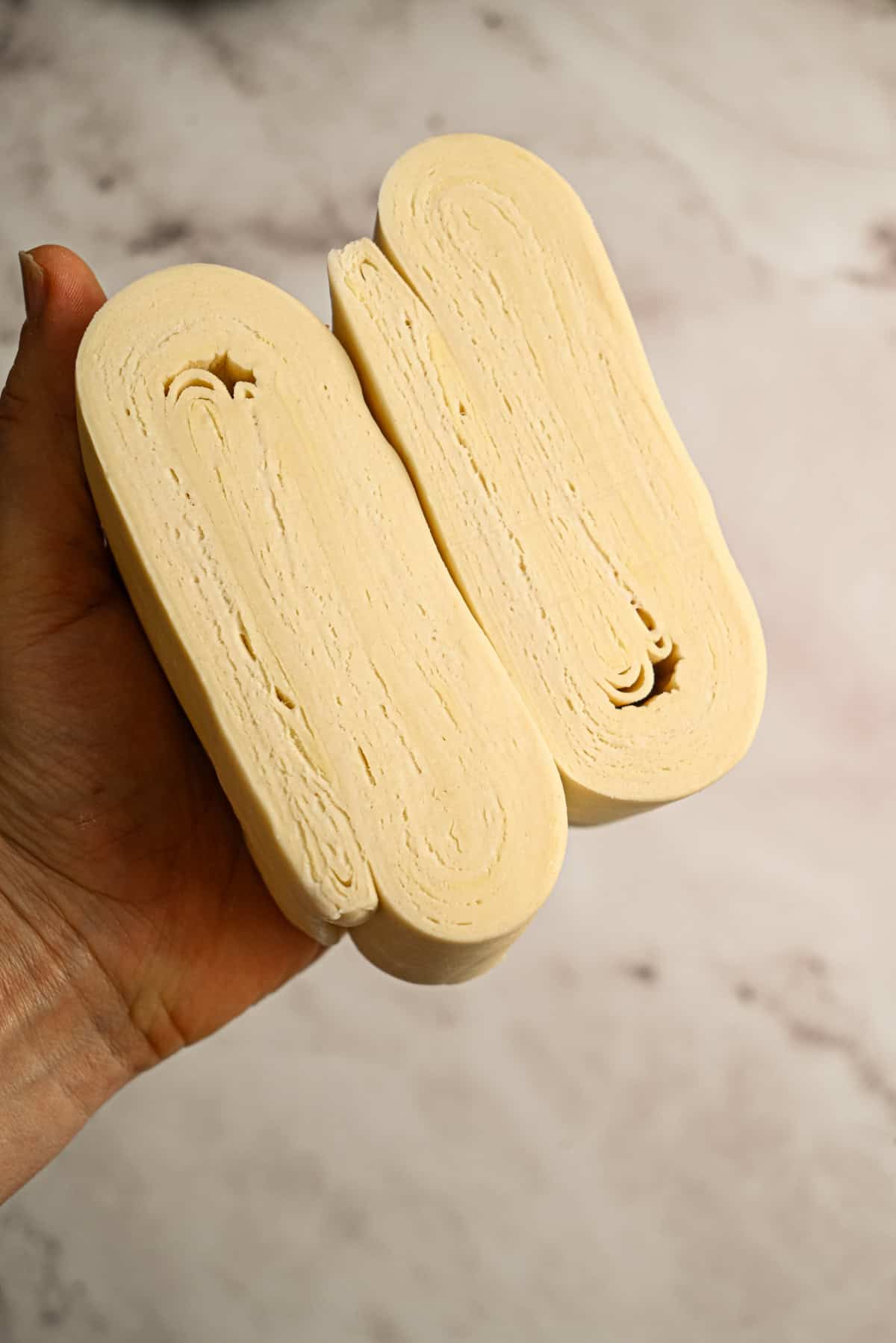
- Chill the dough for a minimum of 2 hours in the refrigerator after the final turn.
Cooking temperature and time
The cooking temperature and time will depend on the recipe you use the puff pastry in. Puff pastry does best in an initially hot oven of around 200°C/400°F to allow the pastry to puff up nice and big. The time needed for this depends on how the puff pastry is being used. A good puff pastry will quadruple in height, and butter leakage should not be an issue. If you find your pastry is leaking, or it’s not rising well it is probably the butter that hasn’t been incorporated evenly.

Storing
Unbaked puff pastry can be frozen for up to 4 months to use at a later date. If you’re freezing it, let it thaw in the refrigerator or at room temperature before rolling it out. Don’t let the dough warm up so the butter doesn’t melt and the dough becomes too floppy to use. This recipe makes around 600g. It can be easily doubled if you’d like to make extra pastry for future uses.
Puff pastry recipes
Two of my favorite ways to use puff pastry are by making flaky Elephant Ear Cookies (Palmiers) or apple hand pies! Or, see below for more sourdough discard recipes.
Sourdough Puff Pastry
Ingredients
- 225 g all-purpose flour
- 60 g sourdough discard starter
- 100 g cold water
- 1/2 tsp salt 1/4 teaspoon if using salted butter
- 30 g butter
Butter packet
- 200 g butter
Instructions
Day 1
- In a bowl, add the flour, sourdough starter, water, and salt and knead it into a shaggy dough. Bring it onto a clean work surface and knead it to bring into a dough ball. Work in 30g butter and knead for 4-5 minutes into a smooth ball then place it in an airtight container in the refrigerator for 8-20 hours. 225 g all-purpose flour, 60 g sourdough discard starter, 100 g cold water, 1/2 tsp salt, 30 g butter
Day 2
- Take two sheets of parchment paper. Fold or crease the parchment into a 15cm/6inch “packet”. Lay the slices of butter on one sheet of parchment and place the second sheet on top. Using a rolling pin, pound the butter out into the square, push and nudge the butter into the corners so it fills the packet evenly. 200 g butter
- Place the butter rectangle in the refrigerator for around 10 minutes to firm up slightly, but ensure it’s still a little pliable and not rock hard. If you're making the butter block in advance, take it out 15 minutes before you laminate the dough, to slightly soften. You want the butter and dough to be similar consistency.
Laminating
- Take the dough from the refrigerator and roll it out in front of you into a 23cm (9") square. Take the cool butter and set it in the center of the dough at a 45° angle, so it looks like a diamond inside the larger dough square.
- Fold the four corners of the dough over the butter, meeting in the middle.Pinch or press the seams together so the butter is fully enclosed, no gaps.
- Gently push with a rolling pin a few times along the length of the dough to help work in the butter. Roll the pastry out into a rectangle and fold it into thirds, like a pamphlet. That was a single turn.
- Rotate the dough 90°, roll again into a rectangle, fold again into thirds. This completes 2 turn. Wrap the dough and chill for 20–30 minutes to keep butter cold and relax the gluten. Continue with 4 more turns, so there are 6 in total, chilling between every 2 turns.
- After all the turns are completed, let the dough chill for a minimum of 2 hours in the refrigerator before rolling it for baking.
Baking Temperature and Time
- The baking temperature and time will depend on the recipe you use the puff pastry in. Puff pastry does best in a hot oven of around 200°C/400°F to allow the pastry to puff up nice and big.
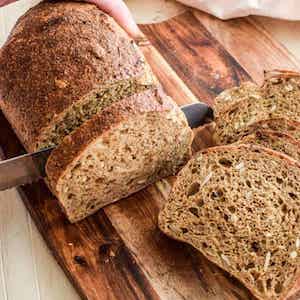



I tried both the puff pastry and croissant discard recipes and both were wonderful!! No problems whatsoever! Highly recommend!
This is an amazing recipe. I make it at least twice a month and I agree, the discard makes it an absolute pleasure to handle. I had to start searching for creative ideas/recipes to use all the puff I make! Haha!
Actually I think you were doing it right! The English seems to be “distemper” so indeed with the inversion on the “r”.
Feeding my surdough just now… so let’s see 😉
thanks again for all the beautiful and inspiring recipes.
Nice way of using a discard starter, thanks for pointing this out! Will definitely try it over the weekend (and let you know how this compares to a classic “pâte feuilletée”).
One note: I had never heard of the English “detemper”. In French, we say “détrempe” (for flour which needs to absorb water, and is usually cooled down). Funny to see how the “r” shifted from the ‘t’ to the end of the word.
Ohh I’ve been spelling it wrong the entire time! Thank you for pointing that out! I hope you enjoy the recipe 😀
Thank you SO much – this pastry is delicious! I used it to make sausage rolls topped with sesame seeds for Christmas, and they looked and tasted amazing 🙂 My family loved them 🙂 The pastry was buttery, light, gorgeous with a very slight tang. A million times better than store bought. I think I’ll be making these every year now!
So happy to hear you loved it!! 😃 thank you!
How do you convert the amounts to cups and teaspoons or tablespoons? I’ve all but given up trying to figure this out. Thank you!!!
Hey Deb, for American cups it’s around 1 3/4 cup + 1/2 tablespoon flour, 1/4 cup sourdough discard, 1/3-1/2 cup water, 1 cup butter.
Omg this is the best puff pastry recipe. I will never use store bought again. It was so light airy, flaky delicate but can hold toppings. My friends could not stop eating it. Truly amazing thanks so much for sharing! I will always have some in my freezer. I used it after thawing in the refrigerator it couldn’t have been better.
So happy you loved it!! Thank you!
I’m excited to try this, thanks for explaining your recipe and process so thoroughly. For this recipe, do the shaped pastries need to proof before baking?
Hey, nope they don’t! All the rising for this pastry comes from the butter 🙂
If you double the recipe, can you just roll it double the size, or must you do it twice? Thank you!
You can double the recipe and just roll it a bit bigger 🙂
Im really interested to make it with you recipe , but I am totally new to puff pastry, wish I could watch a video from you to follow .