A Beginner’s Sourdough Bread Recipe
This is a simple, reliable sourdough bread recipe, perfect for beginners. The process gives you a golden, crusty loaf with a soft, open crumb. If you’re new to sourdough, read through the steps before you begin so you understand the timing and rhythm. Once you’ve got the hang of it, this method honestly becomes second nature.

Sourdough bread
Sourdough bread rises naturally with no commercial yeast needed. Instead, it uses wild yeast and beneficial bacteria (lactobacillus) from a sourdough starter.
The yeast produces carbon dioxide to lift the dough, while the bacteria create lactic and acetic acids that give sourdough its flavour. The long fermentation makes sourdough easier to digest and develops that classic tang.
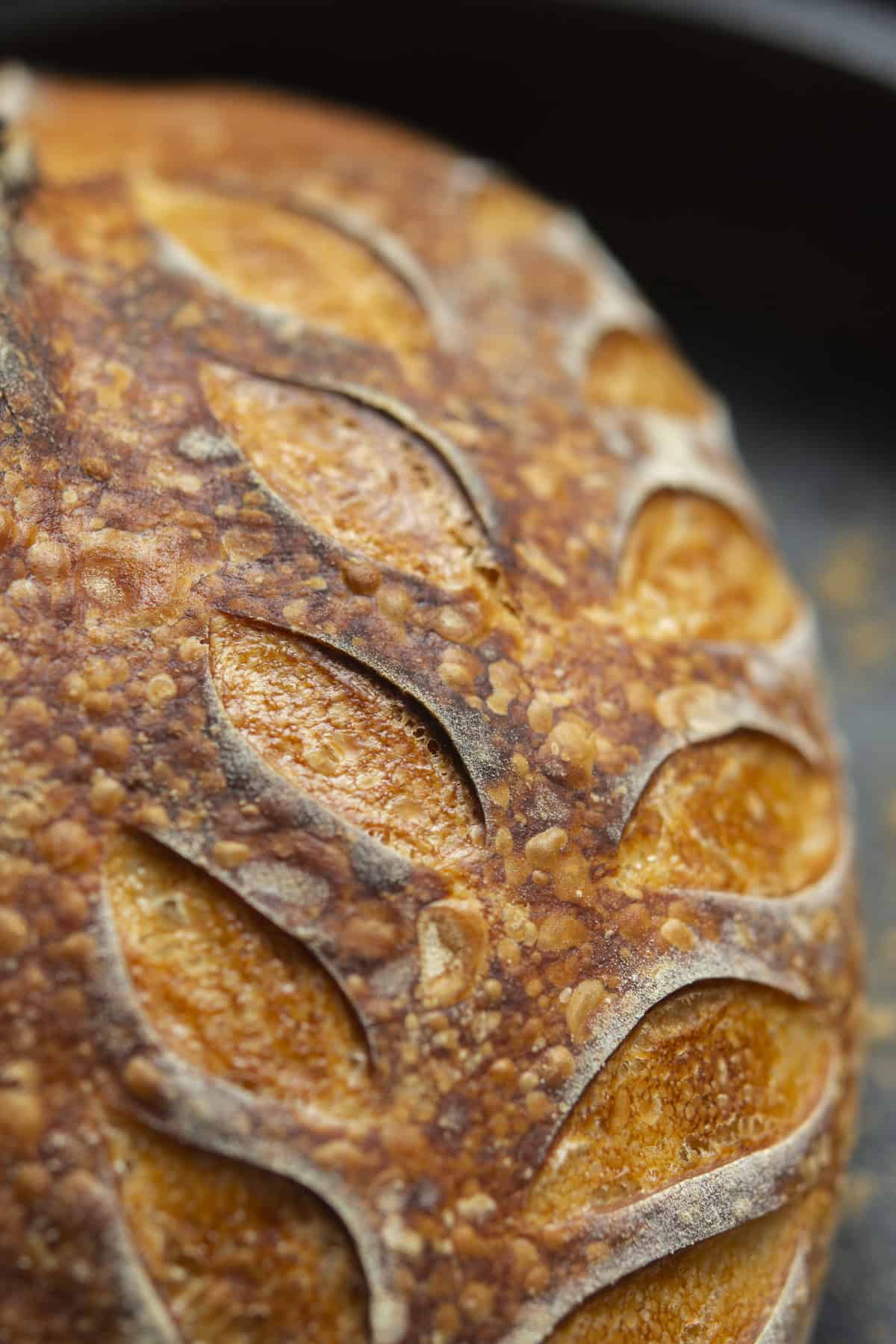

The sourdough starter & levain
You’ll need an active sourdough starter before you begin. I keep mine at 100% hydration which means equal parts flour and water by weight. Keeping the acid levels balanced helps the dough stay strong and easy to handle and regular feeding keeps your starter healthy and reduces excess acidity. Read more on how to maintain a sourdough starter.
Feeding ratios
I usually feed my starter at
- 1:2:2 doubles within about 6 hours at 21 to 26 °C (70 to 78 °F).
- 1:3:3 takes longer to rise and is useful for overnight feeds.
Both are 100% hydration (equal flour and water by weight).
Creating a levain
A levain is a portion of your active starter fed and grown specifically for the loaf you’re making. To make one:
- Take a small amount of your active starter.
- Mix it with fresh flour and water (for example, 1:2:2).
- Let it rise at room temperature until it doubles and looks bubbly and domed.
Use the whole levain in your bread dough. It’s essentially your freshly-fed, ready-to-use starter. After taking out what you need, feed the remaining starter (about 30g but it can be less) and store it in the fridge for next time. Even a small amount can be built back up again. Save any leftover discard for sourdough discard recipes.
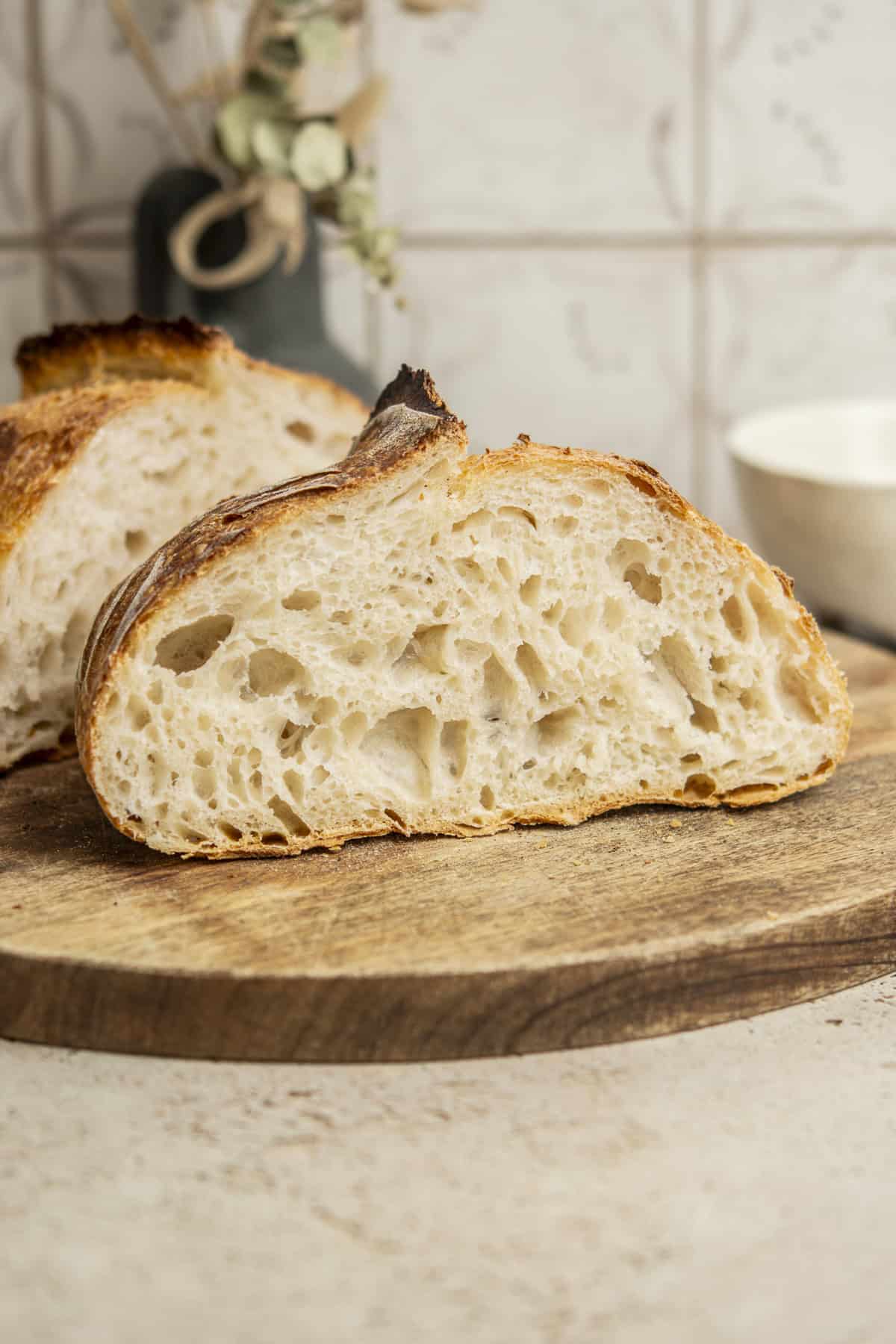
Tools you’ll need
Baker’s schedule (example)
You can adjust these times to suit your day.
| Time | Step |
| 8 am | Feed your starter and create levain |
| 1 pm | Autolyse (mix flour and water) |
| 2 pm | Add levain and salt |
| 2:30-7:30 pm | Bulk ferment with folds |
| 7:30 pm | Shape, then cold-proof overnight |
| Next morning | Bake |
If you run into problems, see my Sourdough Troubleshooting Guide or watch my step-by-step video.
Method (overview)
- Feed your starter so it’s ready to go.
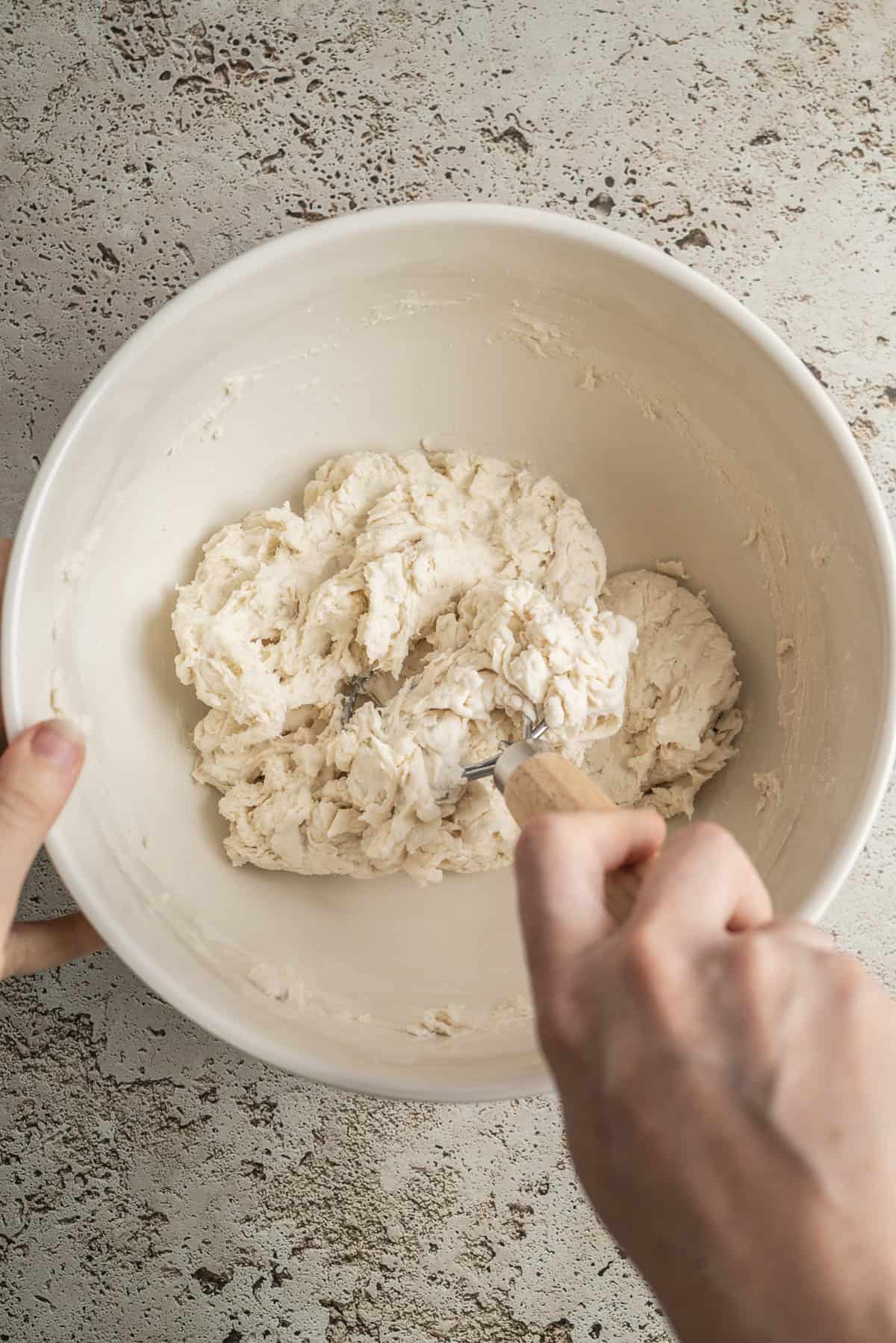
- Mix the flour and water until no dry bits remain, then cover and rest for at least 30 minutes (up to 2 hours). This allows the flour to hydrate and start forming gluten naturally.

- Add your bubbly levain and salt to the dough. Use wet hands to mix until it forms a sticky, rough ball and knead it in the bowl for 5 minutes. Cover again.
Folding and bulk ferment
- Stretch and fold the dough every 30 minutes for 3 hours. Each fold builds strength and structure. You could do this with coil folds or traditional stretch and folds.
Stretch and folds
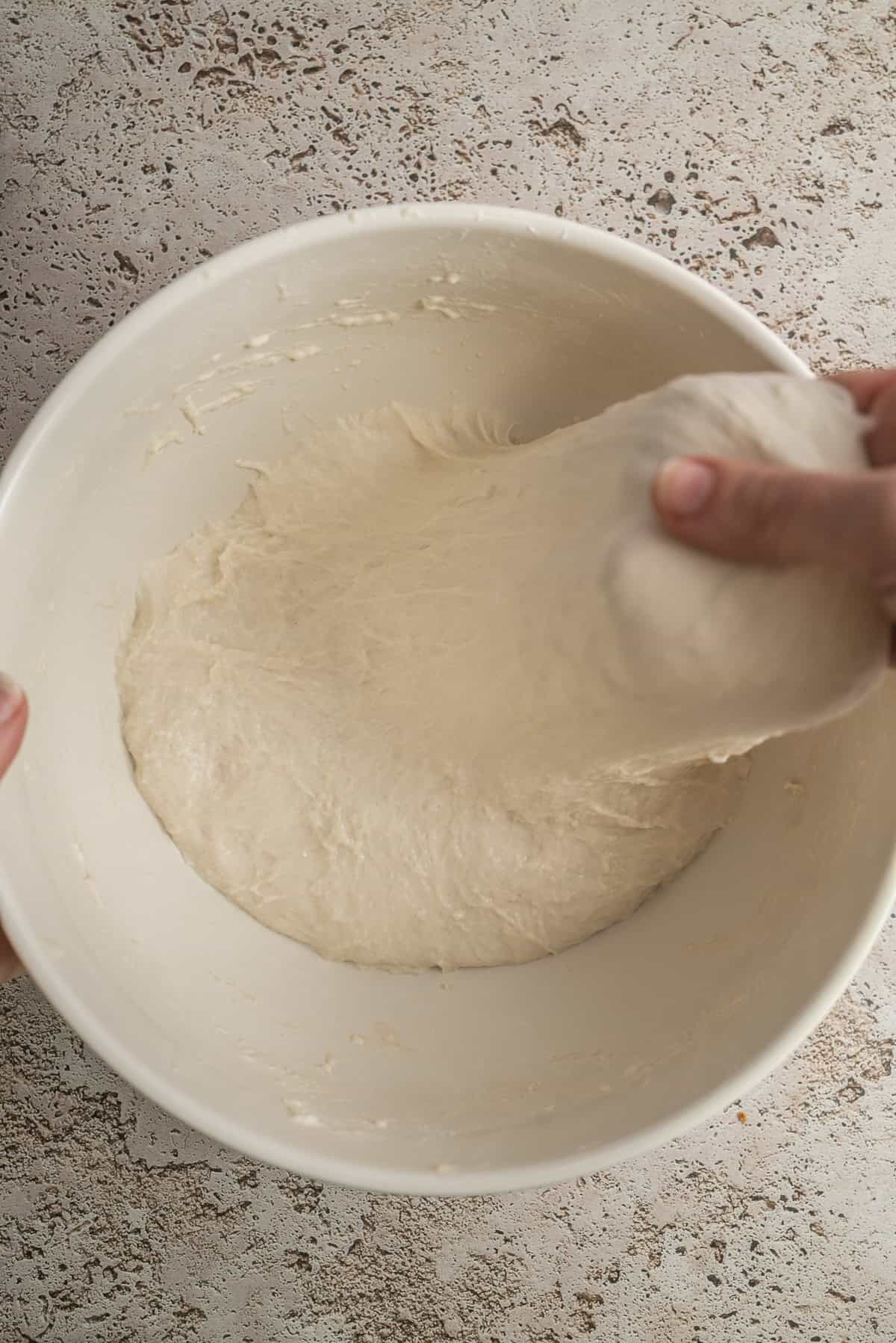
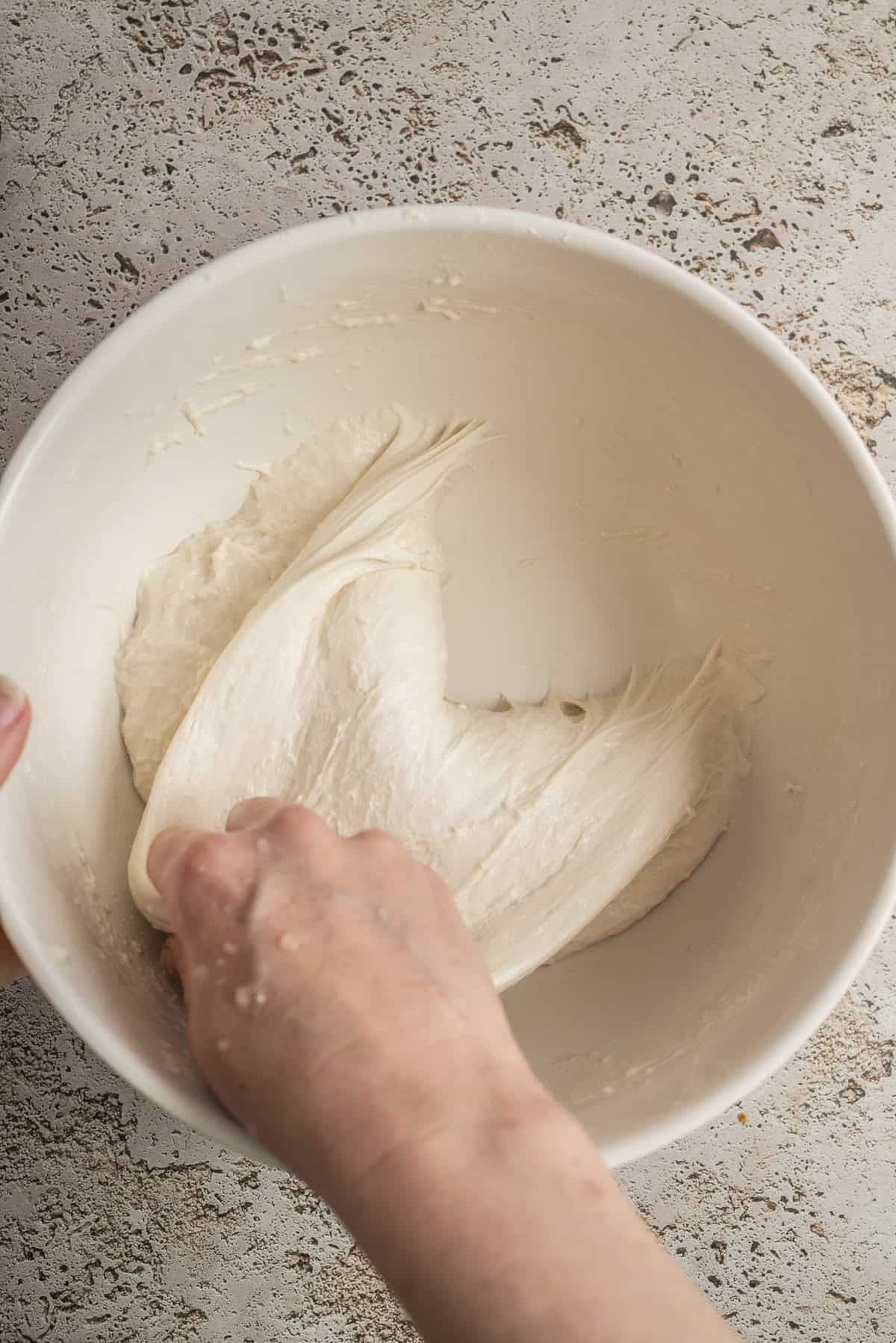
Coil folds
Bulk fermenting continued
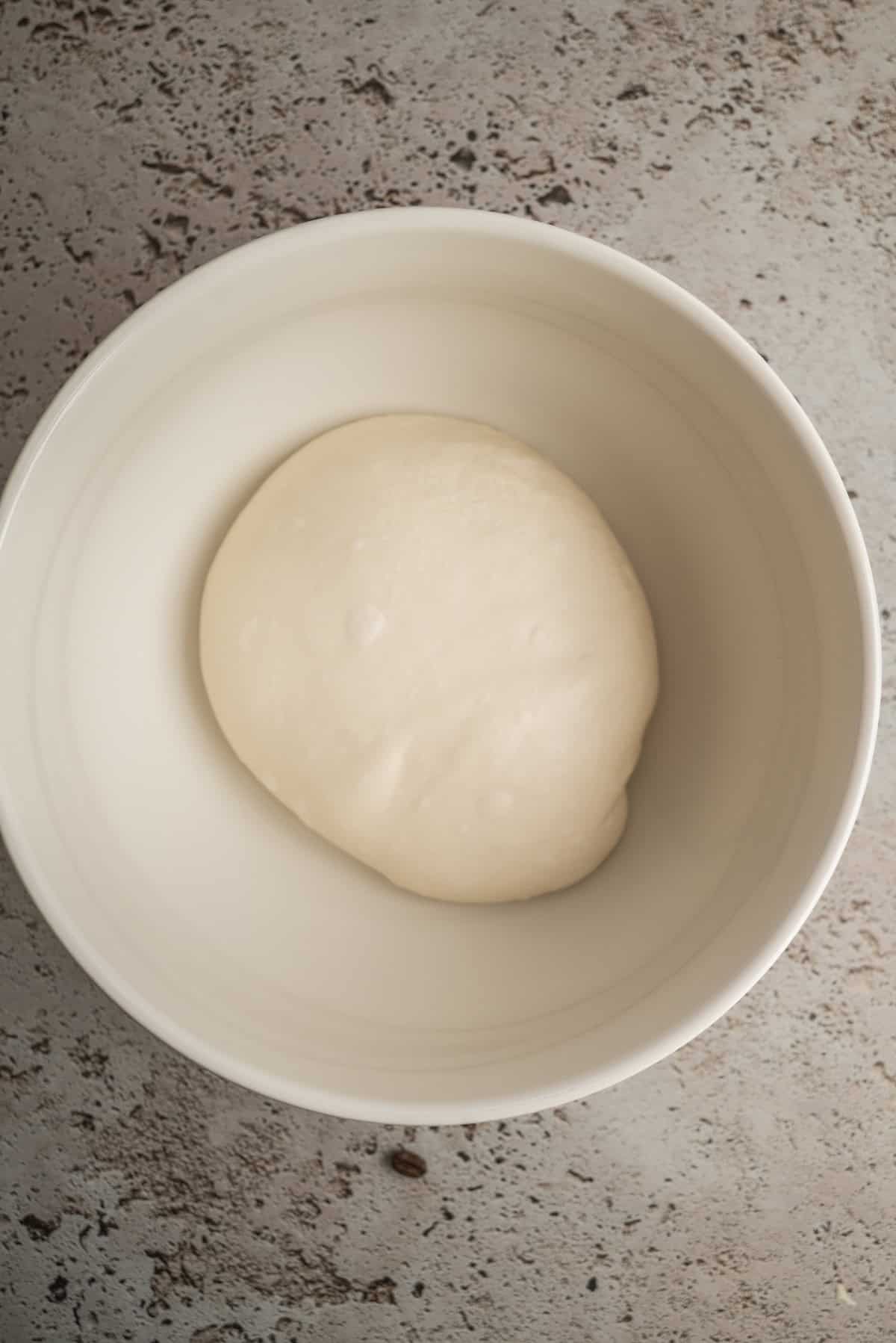
- After your last fold, place the dough in a clean bowl. Keeping the bowl clean stops dried dough from gluing itself on and makes it much easier to clean up later.
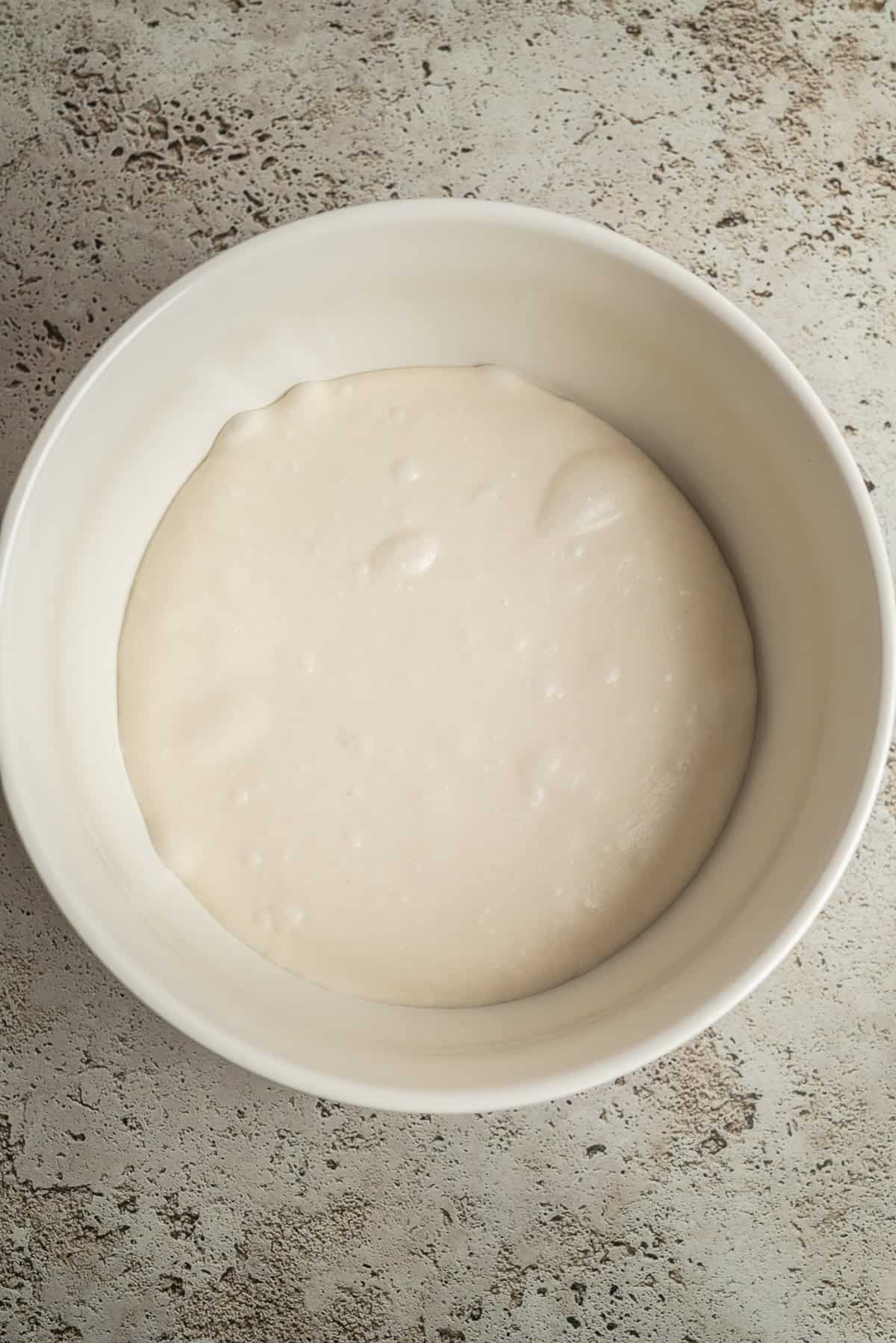
- Let the dough continue bulk fermentation until it’s about 40-50% larger than when it started. It should feel lighter and airier, with some bubbles forming.

Note: Ideal bulk ferment temperature is around 24 °C (75 °F). Cooler rooms take longer and in warmer ones the dough move faster.
Shaping and cold proofing
If you’ve made this recipe before, you might notice I’ve simplified my shaping method. I now use an easier fold-and-roll approach that still builds great structure without being too technical. If you’d prefer to follow my original, more detailed shaping method, you can still find it in my YouTube video here.
- Lightly flour your bench. Tip the dough out gently.

- Gently stretch the dough into a loose rectangle.

- Do a pamphlet fold and fold the bottom third up, then the top third down.

- Turn the dough dough 90 degrees.

- Roll the dough up, gently pressing down with each roll to keep tension as you go.
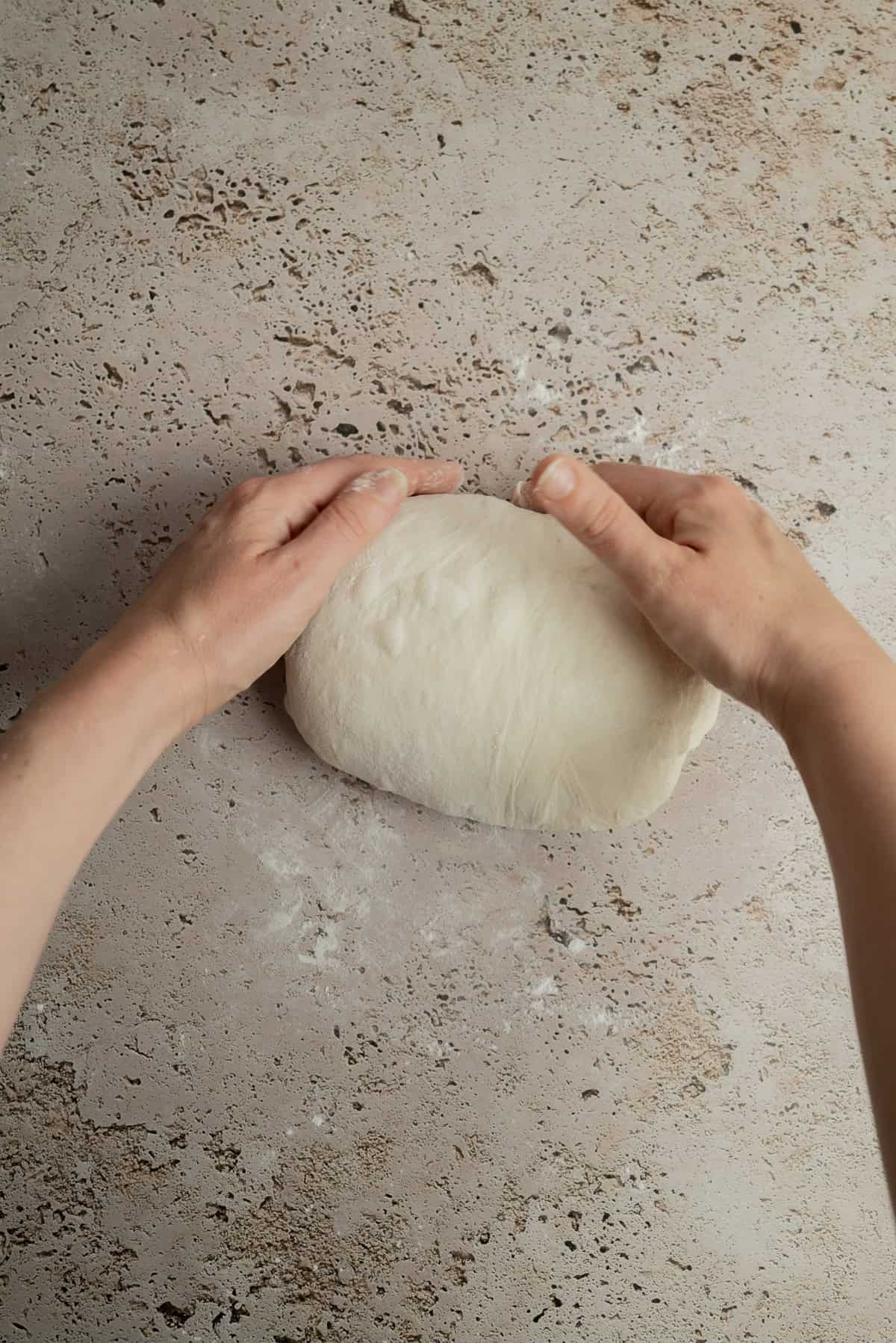
- Pull it toward you gently to build surface tension and tuck in the sides.

- Place seam-side up in a floured basket. Stitch the top lightly to help it hold height.
- Cover and refrigerate for 12–24 hours to proof slowly.
Note: Dust your basket or floured cloth with rice flour or a 50/50 mix of rice and bread flour. Rice flour doesn’t absorb much moisture, so it’s the best way to stop dough from sticking during long proofing.
Baking

- Flip your dough into it (seam-side down) into your dutch oven and score the dough with a razor or sharp knife.

- Bake covered for 20 minutes, then uncover and bake another 15 to 20 minutes until deep brown.

Dough proofing
Under-proofed dough
An under-proofed dough hasn’t fermented long enough. It will feel tight and dense, and won’t hold its shape when you try to stretch it. After baking, the crumb will be heavy with small, uneven holes and a chewy thick crust. The loaf might burst where the dough tried to expand too late in the oven.
If this happens, extend your bulk ferment next time. The dough should feel lighter and slightly puffy before shaping.
Over-proofed dough
An over-proofed dough has gone too far. It looks very soft and airy, but it feels weak and sticky when you try to shape it. In the oven, it can collapse or spread out rather than spring up. The crust may brown unevenly and the crumb can seem gummy or flat.
If this happens, reduce your ferment time or keep the dough somewhere cooler next time. Aim for a dough that’s risen about 40 to 50% and feels elastic but not fragile.
Trouble shooting tips
- Dough sticking to your hands: Wet your hands during folds to stop it sticking.
- Dense loaf: Under-fermented. Let bulk go longer next time.
- Flat loaf: Over-proofed; shorten the proofing stage.
- Runny starter: Feed a higher ratio (1:3:3 or 1:4:4) to strengthen it.
Adding inclusions (seeds, nuts, cheese, etc.)
Add inclusions after completing the folds during bulk fermentation. This lets the dough build some strength before you mix in anything heavy or textured.
How to add:
- Lightly flatten the dough into a rectangle with wet hands.
- Evenly sprinkle half your inclusions over the surface.
- Fold the dough up like a letter (bottom third up, top third down).
- Turn the dough 90 degrees, then sprinkle on the rest of the inclusions.
- Roll it up into a log, then gently shape it into a ball. Let the dough continue bulk fermentation.
How much to add:
- Around 15-25% of the total flour weight works well for seeds, nuts, or grains.
- For cheese or dried fruit, use a bit less like 15-20%, as they release moisture or sugar.
More sourdough recipes

A Beginner’s Sourdough Recipe
Ingredients
Levain (this will all be used in the dough)
- 20 g sourdough starter
- 40 g all-purpose flour
- 40 g water
Dough
- 400 g bread flour or all-purpose flour, at least 11% protein
- 285 g water
- All the levain
- 8 g salt
Instructions
Levain
- In a small bowl, mix the levain ingredients until well combined and smooth.
- Transfer to a clean jar or glass and cover with a loose lid or damp towel.
- Let it sit at room temperature (around 22-26 °C / 72-79 °F) until it has at least doubled and looks bubbly and domed. This usually takes 4 to 6 hours, depending on room temperature.
Dough
- About an hour before the levain is ready, combine the flour and water in a large bowl. Use wet hands to mix until no dry bits remain. Cover with a plate or damp towel and rest for 30 to 60 minutes.
- Add all the levain and salt. Mix with wet hands until the dough is sticky and roughly combined. Give it a few slap and fold kneads in the bowl to begin creating structure. This is when you lift the dough slightly and slap it back down into the bowl, folding it over itself. After this, cover the bowl and let the dough rest for 20 minutes.
- Over the next 3 hours, perform stretch and folds (or coil folds) every 30 minutes to build strength. Keep your hands damp to prevent sticking. It’s 5 to 6 sets total. After each fold, cover the dough and let it rest until the next one.
- After the final fold, transfer the dough to a clean bowl and cover it to finish fermenting.
- Let it rise in a warm spot until it looks puffy, jiggles slightly when you move the bowl, and has grown about 40-50% (not doubled). This might take between 1-3 hours, depending on your room temperature, so watch the dough, not the clock.
- Tip: Ideal bulk fermentation temperature is around 24 °C (75 °F). Cooler kitchens take longer, warmer ones the dough will rise faster.
Shaping
- Line your banneton with a towel and flour it well with rice flour or a 50/50 rice and bread flour mix.
- Turn the dough out onto a lightly floured surface and gently shape it into a rectangle.
- Fold the bottom third up, the top third down, then turn it 90 degrees. Roll the dough up, gently pressing down with each roll to keep tension as you go.
- Pull it gently toward you to build surface tension and tuck in the sides.
- Place seam-side up in the floured basket and lightly stitch the top to help it hold height.
Cold Proof
- Cover the basket with a floured tea towel or slip it into a large plastic bag to prevent drying out and refrigerate for 12-24 hours.
Baking
- Preheat your oven and Dutch oven to 230 °C (450 °F) for at least 30 minutes.
- When hot, carefully remove the Dutch oven and flour the base.
- Take the dough from the fridge, flip it gently out of the basket, and place it seam-side down into the pot.
- If using a large pot, transfer it on parchment paper to lower it in easily.
- Lightly dust the top with flour and score the surface with a razor or sharp knife.
- Bake covered for 20-25 minutes, then uncover and bake another 15-20 minutes until deep brown.
- Cool for at least 2 hours before slicing to let the crumb set.
Notes
Tip for cooler weather sourdough
Sourdough rises more slowly in cool rooms. To help it along, keep your dough somewhere slightly warm, like inside your oven that’s off but with the light on or beside a cup of boiled water. You can also use slightly warm water (around 30 to 35 °C / 85 to 95 °F) when mixing your dough to give fermentation a gentle boost.Dough proofing
Under-proofed dough
An under-proofed dough hasn’t fermented long enough. It will feel tight and dense, and won’t hold its shape when you try to stretch it. After baking, the crumb will be heavy with small, uneven holes and a chewy thick crust. The loaf might burst where the dough tried to expand too late in the oven. If this happens, extend your bulk ferment next time. The dough should feel lighter and slightly puffy before shaping.Over-proofed dough
An over-proofed dough has gone too far. It looks very soft and airy, but it feels weak and sticky when you try to shape it. In the oven, it can collapse or spread out rather than spring up. The crust may brown unevenly and the crumb can seem gummy or flat. If this happens, reduce your ferment time or keep the dough somewhere cooler next time. Aim for a dough that’s risen about 40-50% and feels elastic but not fragile.Levain
A levain is a small offshoot of your main starter, fed and grown just for this loaf. The whole thing goes into your dough. When you feed your starter, split it into two portions:- One for the levain: feed it fresh flour and water in a clean jar and leave it to rise until bubbly and doubled.
- One to keep: feed the remaining starter as usual and store it in the fridge for next time.




Hi Elien,
Just baked my first sourdough loaf this morning. It turned out to be perfect! The crust was so nice and chewy, the inside was moist and the right texture, and the shape was just like your pictures. I was surprised because when I scored the dough, it did not hold its shape – I used a razor blade but it was difficult to cut, not like your video. Thanks so much for the great instructions. I have learnt so much. I have my starter in the refrigerator – ready for #2!
Yay so happy to read about your successful first bake! Bring on round 2 😀
Hello,
The first time I made it bread turn out perfectly!
However, second and third and the end of bulk proofing, it was all sticky and I had to chuck it! I’m tried to steal cold proof with the third one but it just stuck on to the tea towel after.
Is this over proofing or how do I troubleshoot this please?
Thank you!
Heya, I would have a look first at your starter. Is it refreshed often and not too acidic? Too much acid can ruin the dough structure and make it very sticky.
Otherwise, if your starter isn’t the issue then it might be over proofing yes. You could play around with reducing the amount of starter in the dough if your environment is quite warm.
Hi
Just reading your nutrition information and it has the serving size as 1 Gram. As I’m type 1 diabetic I need to know the carbs in food.
I am very interested in your starter and sourdough recipe. Sounds and looks delicious.
Thank you
Cheers Sue
Hey Sue, the serving size is meant to be 1 serving, not one gram but unfortunately, the nutritional calculator that comes with the recipe card isn’t very consistent or accurate! I suggest finding one online that’s a bit better and entering your own numbers.
Love your site and recipes. Got confused with recipe for beginners sourdough. Ingredients say 330ml water, instructions say 330gr water. I stuck with the grams as I’ve never made sourdough using mls.
Maybe a typo?
Hey! Grams and ml are the same when it comes to water 🙂 1gram water = 1ml water too, but I will update it to avoid confusion
Hello! I made this recipe, and it was a good loaf! I have a question: whenever I bake a sourdough bread in a Dutch oven, despite putting a baking sheet or a baking steel on the shelf below it, the bottom crust is too hard to cut through without difficulty, and you can’t chew it. Is there a solution to this, or should I just not bake it in a Dutch oven? I even slightly underbaked this one this morning- still tough and chewy on the bottom. Is there an alternate way to bake to avoid this? Thank you! Love your site!
Hi carol my friend gave me a tip with the bottom being hard. Put a good layer of coarse salt on the bottom of the dutch oven and then put your sourdough with the parchment paper on it. It creates a tiny space so the bottom doesnt get over baked. Hope that helps.
Hi,
Great recipe, we have being making two loaves a week now for over a year, love it. The only question we had was after baking and leaving for at least two hours plus, today five hours, looks perfect when cut however it is always quite sticky, is there a fix for this.
Thanks 😋
William
Hey William, a sticky loaf sounds like it could be a bit under proofed. You could extend the bulk ferment a bit before shaping or pop it in a warmer spot 🙂
Hi,
Love your recipes!
What would you recommend for gluten free version?
Thanks 😊
Ran
Eline,
Just to let you know, I made the loaf today and rather than preheating the cooking vessel I put the floured and slashed loaf into a baking cloche and put it into a cold oven. Then turn the heat on to 425 degrees F, and the timer to 30 minutes. At thirty minutes remove the cover and baked it for another 25 min. to an internal temperature of 205 degrees F. It came out great. Eliminating dealing with the super hot baking vessel makes it a lot more attractive especially to the novice baker.
Gene, thanks for sharing! Great to know it works well without a preheated pot too 🙂
Hi Ellen,
Thanks for this recipe! I have just started my sourdough journey and love coming across different techniques, such as your coil fold! I was on a mission to get more holes, as previous loaves have been more dense. Your folding with wet hands, creates lovely bubbles. Finally, I love that in the morning, there is no faff, just straight into the oven! Other recipes you have to shape, leave on the counter etc. I’ve made a few of your Plain white loaves, my first was the best so far. I reduced the water so only used 303g (my flour has a lower protein value). It took longer to prove, I had to pop it on my boiler which worked a treat (I’m in the UK).
My question to you is this: you say ‘now you can add seeds’ but you don’t say a quanity or method. Other recipes I’ve used for seeded sourdough have a quantity of seed and water ratio (they say to soak first). I added 100g of seed but I didn’t soak first. The dough was definitely less elasticated, I think the seeds affected the water content?! (I used Linseed & poppyseeds).
Any thoughts and advise on this would be appreciated!
Hey Vicki, I’m glad you’ve had success with this recipe! For the seeds, I can add 2-3 tbsp worth without it affecting the dough structure, but that’s only 20-30g. 100g would affect it. I suggest starting with a lower amount of seeds and seeing how the dough feels, and gradually increasing the seeds and water if needed in future loaves. 🙂
Hey Jim, that’s meant to be a link to my sourdough trouble shooting guide. You can find it if you search ‘Sourdough Guide’ on my blog. Unfortunately I can’t view those pictures
Hello Ellen,
Thank you for your careful and detailed recipe. I have made this a few time. The final results have been satisfactory, but I don’t think I have achieved the desired dough consistency. I have follwed the quantities exactly, but I think my dough is too wet. It fails to come together the way yours appears to, especially by the last fold (and before) when it appears to be in a tight loaf shape. My most recent attempt I used a bannetton for the first time. When I finally laid the dough in the cast iron pan it did not hold its shape. After 30 min covered bake, the bread has settled into a boule shape. It looks great, nonetheless. I in the midst of top brown. I am anxious to see the result as I don’t think the covered bake was long enough and the interior was a bit chewy (but still good to eat). Any advice on getting a dryer dough? On my own I would try a bit less water. Thanks, Jim
Hey Jim, I would first take a look at your starter and check that’s at optimal condition . You can reduce the water in the dough but that isn’t the reason for the lack of elasticity. The chewy bread sounds under proofed which again can be related to the starter. Here’s a bit more information.
Jim,
I have followed Elien’s method (not recipe) twice now with fantastic results! My loaves are huge. I use a strong bread flour with approx. 13% protein content. I use 500g of flour with 320g of water. A much lower flour to water ratio than Eilen’s. I have figured out that the flour I use absorbs a lot of water so I started using less water. I also use 150g of starter and 10 g of salt as recommended by Eileen. I use a Rye/Spelt starter. Even though I use less water, I get a huge oven spring and blistering by on my loaves by following Elien’s method including her method for shaping a batard. My loaves stay moist for a few days too.