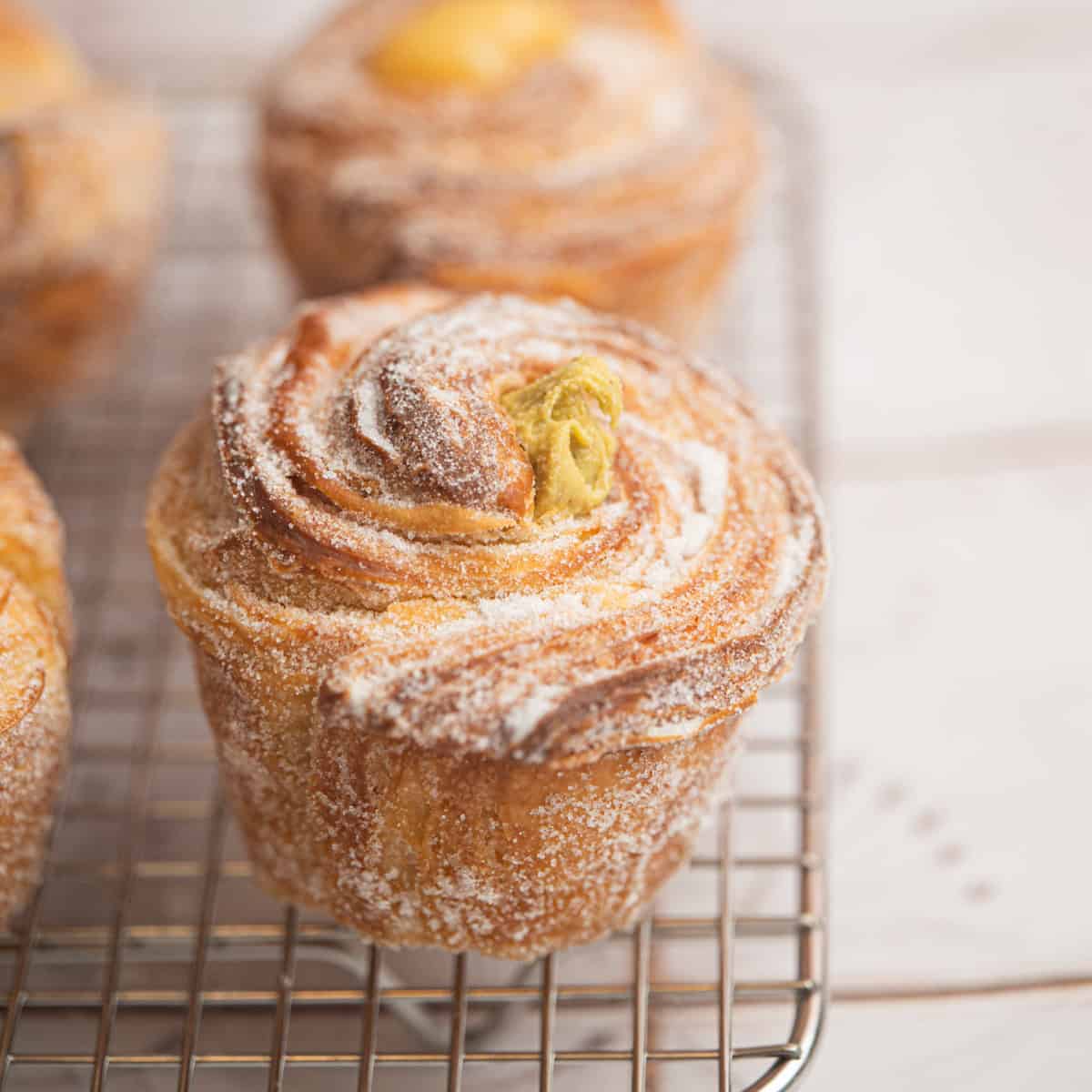
Sourdough Cruffins
Light, flaky, and coated in crunchy sugar, cruffins are so good! A hybrid of a croissant and a muffin, these sourdough cruffins are made with laminated dough and baked in a muffin pan
Ingredients
Levain
- 15 g starter
- 60 g flour
- 60 g water
Dough
- 120 g milk room temperature
- 120 g water
- All the levain
- 455 g all-purpose flour
- 50 g granulated sugar
- 6 g salt
- 50 g unsalted butter room temperature
Butter packet
- 250 g unsalted butter
Coating
- 100 g granulated sugar
Instructions
The evening before
- Feed your sourdough starter to make the levain so it's active by morning. 15 g starter, 60 g flour, 60 g water
Day 1
- In the morning, add the levain, milk, and water to a large bowl and whisk them together to loosen the starter. 120 g milk, 120 g water, All the levain
- Add the flour, sugar, and salt, and use a fork to mix everything into a sticky, shaggy mound. 455 g all-purpose flour, 50 g granulated sugar, 6 g salt
- Tip this onto a clean bench and knead in the butter, and continue kneading for about 5 to 7 minutes until the dough becomes smooth. It will feel quite sticky at first, but keep pulling, folding, and pushing it back and forth, and the stickiness will ease as the gluten develops. 50 g unsalted butter
- Place the dough in a bowl, cover it, and let it rise in a warm place until it has puffed up by about 30-40%. If your kitchen is very cold, you can place the dough in a turned-off oven with a mug of boiled water next to it, and replace the water as it cools.
- Once the dough has puffed up, gently press out the air and pat it into a rough rectangle. Either wrap it in plastic wrap or place it in a rectangular container with a lid, then chill it until it firms evenly before laminating, around 2-3 hours.
Butter packet
- Slice 250g cold butter and lay the pieces side by side on a sheet of baking paper. 250 g unsalted butter
- Place another sheet of baking paper on top and use a rolling pin to gently pound and press the butter into a 20 x 15 cm (8 x 6 inch) rectangle, about 0.5 cm (1/4 inch) thick. To get clean, straight edges, fold the baking paper around the butter to make a neat frame, then press the butter so it fills the frame evenly.
- Refrigerate the butter block until it is firm.
Laminating
- Remove your butter block from the fridge and use a rolling pin to pound it in the parchment paper a bit to make it pliable and mouldable. It should be cold but still bendable.
- On a floured surface, roll the chilled dough into a 20×32 cm (8×12.5 inch) rectangle. The dough should be twice as tall as the butter and about the same width.
- Place the butter block in the center of the dough, folding the top and bottom edges over the butter to fully encase it like a letter. Press this seal closed with your fingertips. Use a sharp knife to make a really shallow slit along the long edges of the dough, not too deep. This helps prevent excessive tension in the dough, especially if it's slightly too tight around the butter block.
- Turn it 90 degrees so the crease where you encased it is vertically in front of you.
- First fold: Apply gentle pressure and roll the dough into a long rectangle about 7-8mm thick. Aim for it to be about 3 times as long as it is wide. Always roll forward with gentle, even pressure and focus on length, not width. Avoid pushing too hard, which can tear the dough and crack the butter layers. Ensure the dough is not sticking to the bench, and dust with more flour if needed.
- If the butter cracks when you tap it out, leave it on the bench for a couple of minutes and try again.
- Once rolled, cut off the uneven top and bottom edges. Brush away excess flour on the dough. Fold the top third of the dough down and the bottom third up, like folding a letter. Wrap in plastic, and refrigerate for 30-60 minutes.
- Second fold: Place the dough vertically in front of you. Repeat the rolling process as before. Cut off scraggly or uneven bits of dough to maintain clean, sharp edges. Fold into thirds, turn, wrap, and refrigerate for 30-60 minutes.
- Third fold: Repeat the folding process one more time, then refrigerate for at least 2 hours or overnight.
Shaping
- Once the dough has chilled, roll it into a large rectangle, approximately 30cm x 40cm (12 inches x 15 inches) and 4mm thick. Cut the dough in half lengthwise to create two long strips, each measuring 15×40 cm (6×15 inch).
- Cut the dough horizontally into 16 strips, each approximately 5 x 15 cm (2 x 6 inches).
- Take one strip and cut it lengthwise down the middle to create two thinner pieces, around 2.5cm (1 inch) wide.
- Take two strips and lay them horizontally next to each other. Overlap the ends by around 1/2cm (1/4 inch) to create one long strip. Now, beginning from the center, roll it up into a coil. It's hard to explain, so please see the post for a visual guide.
- Place the rolled dough into a muffin pan so the spiralled layers are visible at the top. Make sure they are tucked in well, or else they can get a bit misshapen in the oven later.
- Let them rise until doubled in size. It can take 4-7 hours, but the timing will depend on your room temperature. Don't rush this step. Once they are risen, you should clearly be able to see the layers.
- Preheat the oven to 200°C/400°F.
- Place the cruffins in the oven and bake for about 20-25 minutes until they’re deep golden brown.
- Let the cruffins to cool in the pan for a few minutes before removing them and roll in granulated sugar. 100 g granulated sugar
- Once they are completely cooled, insert a knife into the middle to create a small hole and then pipe in your favourite fillings.
Notes
- Starter ratio: I feed my starter at 1:3:3 the night before (1 part starter, 3 parts flour, 3 parts water). In a warm kitchen (above 23°C/74°F) this may peak too quickly overnight. If your kitchen is warm, use a higher ratio such as 1:4:4 or 1:5:5 so it rises more slowly and is at peak by morning rather than already past it.
- Bulk ferment visual cue: You're looking for a 30-40% rise, not a full double. The dough should look noticeably puffier. In a cooler kitchen, this may take longer.
- Chilling before laminating: This step is important. After the bulk ferment the dough will be soft and warm. Chilling it first brings it to a similar consistency to the cold butter, which is what gives you clean, even layers.
- Butter leakage during baking: Some leakage is normal since the dough is pressed into a small tin. Place a tray on the rack below to catch any drips. Good proofing significantly reduces leakage, so don't rush the final proof.
- Final proof: Don't skip or rush this step. Underproofed cruffins will seem gummy and dense inside, even if they look baked, and are more likely to leak butter.
- Freezing: Freeze baked cruffins for up to 3 months. Reheat directly from frozen at 170°C/340°F for 10-15 minutes. You can also freeze shaped but unproofed cruffins; thaw and proof at room temperature for 6-8 hours before baking.
Nutrition
Serving: 1cruffinCalories: 348kcalCarbohydrates: 40gProtein: 7gFat: 18gSaturated Fat: 11gPolyunsaturated Fat: 6gTrans Fat: 1gCholesterol: 60mgSodium: 234mgFiber: 1gSugar: 11g
Tried this recipe?Let us know how it was!