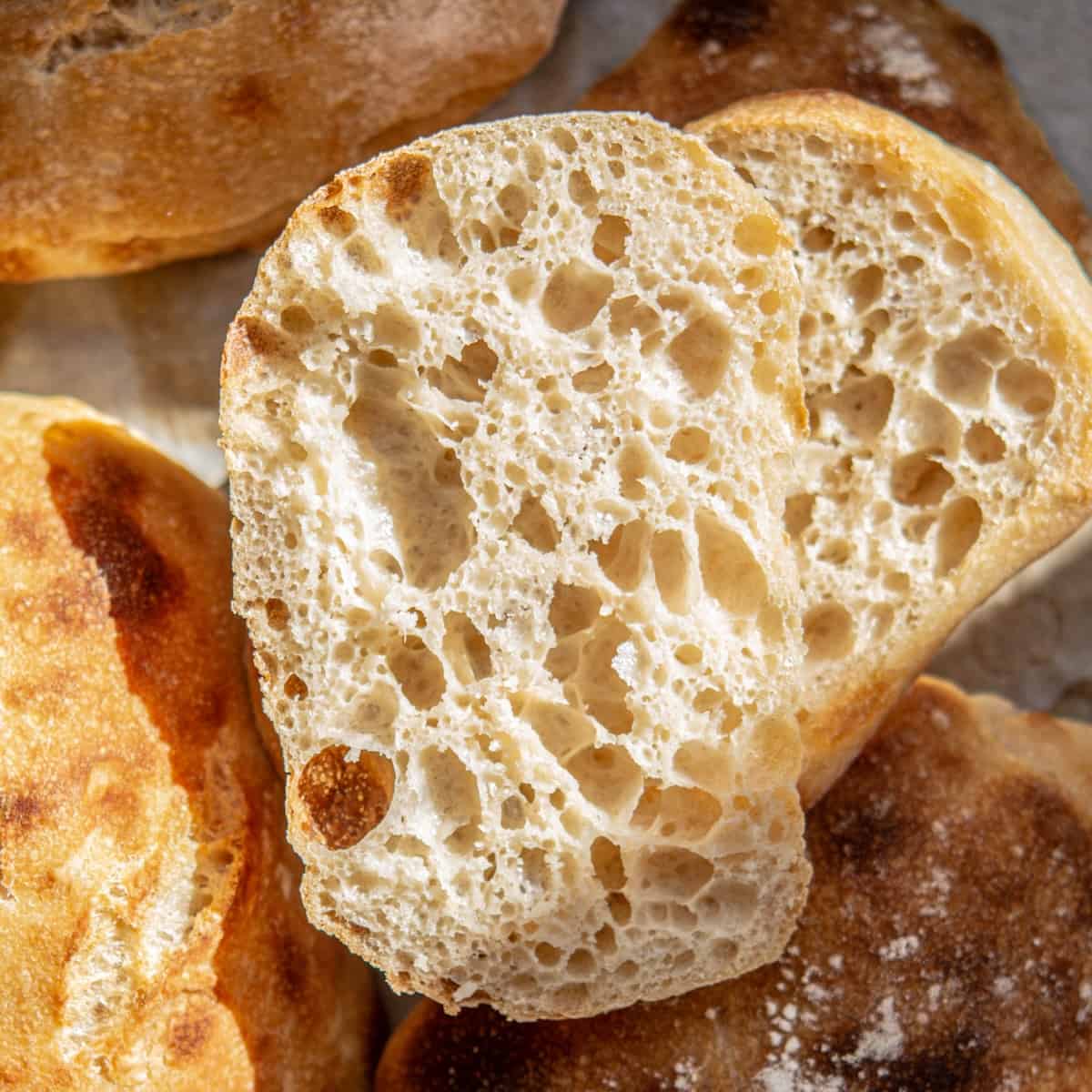
Sourdough Ciabatta Rolls
These sourdough ciabatta rolls are light and airy, with a chewy golden crust. They’re very easy to make, with a high hydration dough, rustically cut into squares and baked.
Ingredients
Levain
- 35 g starter
- 35 g all-purpose flour
- 35 g water
Ciabatta dough
- 420 g bread flour
- 340 g water
- 13 g extra virgin olive oil
- 9 g salt
- All the levain (around 90g active starter)
Instructions
- In the morning, feed your levain. It needs to at least double, if not triple, but be used before it passes its peak and collapses.
- When the levain has nearly finished rising, mix the flour and water in a large bowl to form a sticky and shaggy dough. Let this rest for at least 30 minutes.
- Add the olive oil, salt, and levain and mix well until everything is combined. This makes a very sticky and wet dough. Let it rest for 10-15 minutes.
Bulk Ferment
- Over the next 3 hours, stretch fold the dough every 30 minutes (6 sets of folds total.)
- You can do traditional stretch and folds, coil folds, or whatever folds you prefer. I like to tuck the dough under itself while I fold it to create a smooth top. Always use wet hands to stop the dough from sticking during folds.
- Let the dough rest between each set of stretches and folds. Cover the bowl with a plate or damp towel to prevent the dough from drying out.
- Initially, the dough will be very sticky and wet, and the first stretch will be very slack. After a few folds, it will hold together more, and the final dough will be very elastic. If your starter was in good condition and not collapsed or too acidic, you will quickly feel improvement as the folds go on.
- After the folds, let the dough bulk ferment in a warm place, ideally around 25°C/77°F, for about 3-5 hours until it shows clear signs of fermentation and has risen by around 60%.
- You can place the dough in a clear container with straight sides to easily tell if it has risen. Add a lid to the container to prevent the dough from drying out.
Cold proof
- The total time will depend on the temperature. Once the dough has risen, keep it covered and refrigerate it overnight.
Shaping
- Generously flour a work surface. Line a baking sheet with a piece of parchment paper and generously dust it with flour.
- Tip the cold dough out onto the floured work surface. Use floured hands to pull the dough rectangle measuring 23x28cm/ 9x11 inches. Use a dough scraper to push the sides of the dough to make them straighter.
- Generously dust the top of the dough with flour and use a bench scraper to cut the dough in half lengthwise. Then, cut it into thirds width-wise to create six pieces. They will be rustic.
- Use the bench scraper or floured hands to carefully pick up the pieces of dough and transfer them to the lined baking tray. Nudge the dough into place with a floured bench scraper, or use floured fingers to tuck in the edges if they have stretched out.
- Leave the dough to rest at room temperature for around an hour until lightly puffier and preheat the oven to 450 °F/ 230°C while the dough rests.
Baking
- After the dough pieces have sat, spray or drizzle the tops of the dough lightly with water. You can also add a few cubes of ice in a pan at the bottom of the oven to create some extra steam.
- Bake the rolls for around 20-25 minutes until deep golden brown. If they are browning unevenly, rotate the oven rack halfway through baking.
- After baking, let the rolls cool right down on a wire rack to room temperature before slicing and serving.
Notes
- Stretch and fold - Using wet hands, take one side of the dough and stretch it up, then pull it over itself. Turn the bowl a quarter turn and repeat this move. Continue stretching and folding and turning the bowl until all sides have been folded. That is 'one set' of stretch and folds.
- Coil folding - Using wet hands, coax the sides of the dough up with your fingers and lift it up from the middle and back onto itself. Turn the dough and repeat on all sides, until it forms a ball. If the dough sticks too much to your hands, wet them again
Nutrition
Serving: 1rollCalories: 365kcalCarbohydrates: 70gProtein: 11gFat: 4gSaturated Fat: 1gPolyunsaturated Fat: 3gSodium: 587mgFiber: 3g
Tried this recipe?Let us know how it was!