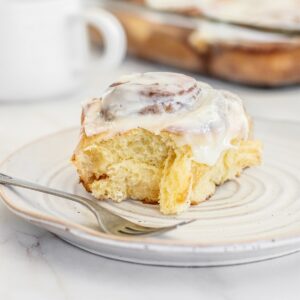
Brioche Sourdough Cinnamon Rolls
These brioche sourdough cinnamon rolls are super soft and fluffy, filled with sweet cinnamon sugar, and topped with a cream cheese glaze.
Ingredients
Stiff starter* (See notes)
- 30 g starter
- 60 g flour
- 30 g water
Brioche dough
- 550 g strong all-purpose flour with around 11% protein
- 50 g granulated sugar
- 4 large eggs
- 125 g milk
- All the stiff starter
- 8 g salt
- 180 g unsalted butter room temperature, cut into cubes
Cinnamon filling
- 75 g unsalted butter softened
- 100 g soft brown sugar
- 2 1/2 tsp ground cinnamon
Frosting
- 60 g cream cheese at room temperature
- 150 g powdered sugar
- 2 Tbsp milk at room temperature
- ½ tsp vanilla extract
Instructions
The night before, feed the starter
- Mix 30g starter with 60g flour and 30g water. Knead into a soft dough ball.
- Place into a lightly oiled jar. Brush the top with a little water so it doesn't dry out overnight. Loosely cover with a lid and leave to rise for 8 to 12 hours, until more than doubled and domed on top.
The dough
- Add the flour, sugar, salt, eggs, milk, and stiff starter to the bowl of a stand mixer fitted with a dough hook. Mix on low until you have a thick, shaggy dough.
- Mix on medium-low for around 5 minutes to begin developing the gluten.
- Add the cubed butter a tablespoon at a time, on medium speed. Wait for each piece to fully incorporate before adding the next.
- Continue mixing on medium for around 15 minutes total, until the dough is smooth, glossy, and pulls cleanly away from the sides of the bowl. Don't be tempted to add more flour.
- Let the dough rest for a few minutes, then check the window pane. Stretch a small piece of dough between your fingers. If it stretches thin enough to see light through without tearing, it's ready.
- Shape the dough into a smooth ball and place into a large greased bowl.
Bulk fermentation
- Cover the bowl and place in a warm spot, ideally around 25°C / 76°F. Let the dough bulk ferment until risen by 30 to 40%. This usually takes 4 to 6 hours but will change depending on temperature.
Cold rest
- Cover the bowl tightly and place in the fridge for at least 4 hours, or up to 24 hours.
Shaping
- Turn the cold dough out onto a lightly floured surface and roll into a 30 x 45 cm (12 x 18 inch) rectangle.
- Spread the softened butter for the filling evenly over the dough. Mix the brown sugar and cinnamon together and sprinkle evenly over the butter.
- Tightly roll up the dough from one of the long sides to form a 45 cm (18 inch) log. Slice into 12 even pieces (using unflavoured dental floss gives the cleanest cut).
Final proof
- Place the rolls cut-side up in a greased 9 x 13 inch (22 x 33 cm) baking tray, leaving a little space between each. Cover with plastic wrap or a dampened towel and let proof in a warm spot until almost doubled and very puffy.
Bake
- Preheat the oven to 190°C (375°F).
- Bake for around 30 minutes, until puffed up and golden brown. If they are browning too quickly, loosely cover with foil.
Frosting
- Beat the cream cheese in a mixer until smooth. Add the powdered sugar, vanilla, and milk and beat until creamy.
- Spread the frosting over the still-warm rolls and serve.
Notes
Stiff starter substitute: You can use 120g of active 100% hydration starter instead. Reduce the milk by 15g to compensate for the extra water. The flavour will be slightly tangier.
Sugar in the starter for milder flavour: If you find the rolls come out too tangy, add 5g of sugar to the stiff starter when you mix it the night before. The yeast uses the sugar quickly, which keeps acidity production lower. Use 20g starter, 80g flour, 40g water, and 5g sugar.
If the dough overheats during kneading: If the dough looks greasy or slick rather than silky, the butter has started to separate. Stop the mixer, put the whole bowl in the fridge for 20 to 30 minutes to cool everything down, then continue kneading.
Bulk fermentation in cool kitchens: Enriched doughs need warmth. If your kitchen is below 20°C, use a turned-off oven with a mug of hot water inside to keep the dough warm. Replace the water with freshly boiled water if it cools down.
Overnight option: For fresh rolls in the morning, shape the rolls in the evening, place them in the greased tray, cover well, and leave at room temperature overnight (only works in kitchens under 22°C / 72°F). Bake in the morning when puffy. In warmer kitchens, refrigerate the shaped rolls overnight and pull them out 2 to 3 hours before baking to finish proofing in the warmth.
Freezing unbaked rolls: Shape the rolls and place them in a greased tray. Let them proof until just starting to puff, then cover well and freeze. Once solid, transfer to a freezer bag. To bake, return them to a greased tray, cover, and let thaw and proof at room temperature (this takes several hours, ideally overnight), then bake as usual.
Storage: Cover and store at room temperature for up to 3 days. Microwave individual rolls for 15 to 20 seconds to soften and warm them back up.
Nutrition
Serving: 1rollCalories: 493kcalCarbohydrates: 65gProtein: 10gFat: 21gSaturated Fat: 13gPolyunsaturated Fat: 7gCholesterol: 114mgSodium: 314mgFiber: 2gSugar: 26g
Tried this recipe?Let us know how it was!